
// Artificial Intelligence · 6 July 2026
Meta Business Agent has arrived. Customer engagement is about to change.
By Tom Reidy
// Key takeaways
- AI is transforming customer engagement & sales processes
- Meta Business Agent handles queries & qualifies leads
- Conversations are becoming the new landing pages
- Agencies need to combine marketing with AI implementation
- Brand voice is crucial for effective AI communication
For years, businesses have measured the success of social media by impressions, clicks and conversions. The objective has largely been to capture someone’s attention long enough to encourage them to visit a website, complete a form or make a purchase. Meta’s latest announcement suggests that model is about to evolve.
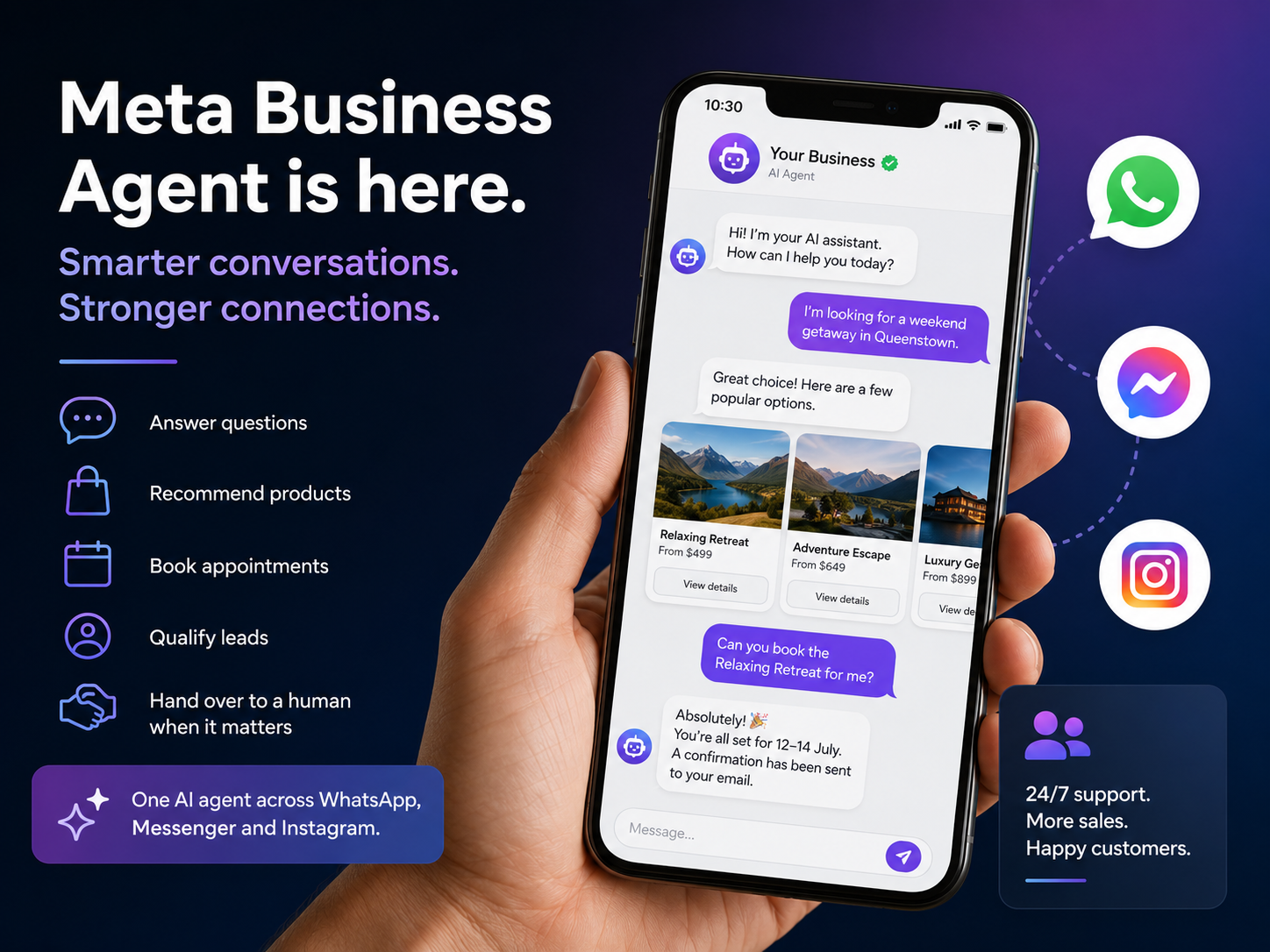
At Conversations 2026, Meta unveiled Meta Business Agent, an AI-powered assistant designed to engage with customers across Messenger, Instagram and WhatsApp. Rather than acting as a traditional chatbot with a fixed list of responses, Business Agent is intended to understand customer intent, answer questions, recommend products, qualify leads and complete actions on behalf of a business. It represents a significant step towards AI becoming an active member of a company’s customer-facing team rather than simply another support tool.
The concept is simple but powerful. Instead of businesses trying to respond to every message manually, Meta is positioning AI as the first point of contact. Whether a customer is asking about pricing, product availability, booking an appointment or comparing options, the Business Agent can handle the conversation naturally and hand over to a human when required.
For marketers, this changes more than customer service. It changes the destination of advertising.
For years, digital campaigns have been built around a familiar journey. An advertisement captures attention, a landing page provides more information, and a form collects a lead. Increasingly, that middle step may become a conversation rather than a webpage. Imagine clicking on an advertisement for a new vehicle, a holiday package or a mortgage broker and immediately being greeted by an AI assistant that understands the campaign, knows the products available and can answer your questions in real time. The conversation itself becomes part of the sales process.
This has the potential to significantly reduce friction for customers. Instead of searching through a website for answers, they simply ask. The experience feels more personal, more immediate and, when implemented well, far more helpful than navigating menus or waiting for a callback.
For agencies, the opportunity extends well beyond advertising. Businesses will increasingly need support designing these AI experiences. The quality of an AI conversation will become just as important as the quality of a website or advertising creative. That means understanding customer journeys, anticipating objections, integrating product catalogues and connecting the AI with booking systems, CRMs and inventory platforms. The agencies that can combine marketing strategy with AI implementation will be well positioned as this technology matures.
Perhaps the most interesting implication is the growing importance of brand voice. An AI assistant can only represent a business effectively if it understands how that business communicates. Is the brand formal or conversational? Does it use humour? How should it respond when a customer is frustrated? When should it escalate to a human? These are no longer just branding exercises for a style guide. They become operational decisions that directly influence every customer interaction.
This reinforces a trend we’ve been watching across the industry. As AI becomes more capable, businesses that have invested in defining their personality and customer experience will see greater returns than those relying on generic responses. Technology can scale conversations, but it still needs clear direction to reflect the values and character of the brand behind it.
It is also worth remembering that AI should enhance, not replace, human relationships. There will always be situations where empathy, judgement and genuine human interaction matter most. The best implementations will likely be those that use AI to handle routine conversations quickly while making it easy for customers to connect with a real person whenever they need to.
While it is still early days, Meta Business Agent feels like one of the most significant platform announcements since businesses first embraced Facebook Pages and Messenger. As AI becomes more deeply embedded into the customer journey, marketers will need to think beyond creating content that attracts attention. The next challenge will be designing conversations that build trust, answer questions and help customers make confident decisions.
For New Zealand businesses, now is a good time to begin experimenting. Understanding your audience, documenting your brand voice and considering how AI fits into your customer experience today will put you in a much stronger position as these capabilities become more widely available. The future of social media marketing may not just be about creating great content. It may be about creating great conversations.
// Global network
Explore the worldwide network
Global case studies, services and offices on tagtheagency.com.